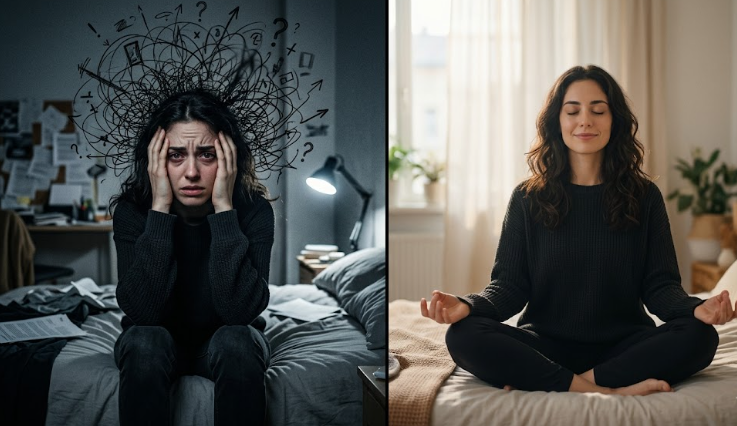
Your mind won’t stop. It’s 2 AM, and you’re replaying that awkward conversation from three years ago. Or you’re worrying about tomorrow’s presentation. Again. This is anxiety and overthinking – and it’s exhausting. You’ve heard that meditation helps. But can it really quiet a brain that never shuts up? Yes. In this guide, you’ll learn meditation for anxiety and overthinking – simple, beginner‑friendly techniques that work. No “empty your mind” nonsense. Just practical steps to find calm.
What is Meditation for Anxiety and Overthinking?
Meditation for anxiety and overthinking is not about switching off your mind. That's impossible — and the goal was never silence. It's about changing the
relationship you have with your thoughts.
Normally, when an anxious thought appears ("I'm going to fail that interview"), you grab onto it. You analyse it. You imagine worst-case scenarios. An hour passes, then two. You feel worse than when you started.
Meditation teaches a completely different response:
notice the thought → label it ("worry") → gently return to your breath. You don't fight the thought. You don't follow it down the rabbit hole. You simply let it be — and come back to the present.
This skill — called
mindfulness meditation for anxiety and overthinking — gradually breaks the loop of rumination. Over weeks of consistent practice, your brain actually rewires itself to stop treating every anxious thought as an emergency.
Why Meditation Works for Anxiety (The Science, Simply Explained)
Your brain has what scientists call the
Default Mode Network (DMN) — a cluster of regions that activates when you're not focused on a task. It's responsible for daydreaming, self-referential thinking, and yes — worry and rumination.
In people who overthink, the DMN runs on overdrive. It's like a radio stuck on static, playing the same anxious loop on repeat.
Here is what regular
meditation for anxiety stress and overthinking does to your brain:
- Calms the amygdala — your brain's alarm system — so it stops firing at every minor stressor.
- Activates the relaxation response — a term coined by Harvard's Dr. Herbert Benson — which is the direct opposite of the fight-or-flight reaction.
- Strengthens the prefrontal cortex — the part responsible for calm, rational decision-making.
- Boosts serotonin and endorphins — natural mood-lifting chemicals your body already produces.
- Reduces cortisol — the primary stress hormone — leading to a calmer nervous system throughout the day.
A landmark study published in JAMA Internal Medicine found that mindfulness meditation programmes significantly improved anxiety, depression, and pain scores. These are not small, temporary changes — they are measurable shifts in how your brain responds to stress.
Benefits of Meditation for Anxiety and Overthinking
When you practice
meditation for anxiety and overthinking consistently — even just 5–10 minutes a day — you begin to notice real, lasting changes:
- Less rumination – You stop replaying the same worries on a loop.
- Lower stress hormones – Cortisol levels drop measurably within weeks.
- Better focus – Your mind wanders less at work, in conversations, and during tasks.
- Emotional balance – You react less impulsively when triggers arise.
- Improved sleep – Racing thoughts no longer hijack your nights.
- Greater self-compassion – You judge yourself less harshly for feeling anxious.
- Physical relief – Heart palpitations, shallow breathing, and tight shoulders ease with practice.
- Reduced panic response – Mindfulness practice gradually lowers the intensity of anxiety attacks.
Even a single
5 minute meditation for anxiety and overthinking can lower your heart rate, slow your breathing, and interrupt a runaway anxious thought spiral.
6 Types of Meditation for Anxiety Relief (Choose What Fits You)
Not every meditation style suits every person. Here are the six most effective types specifically for anxiety and overthinking — try each and find what resonates:
1. Mindfulness Meditation
The most widely researched form of
meditation for anxiety and overthinking. You focus on your breath, notice when the mind wanders, and gently return. No judgement. No force. Just awareness. This is the foundation of everything in this guide.
2. Body Scan Meditation
You mentally move your attention from the top of your head down to your toes, noticing tension, tightness, or discomfort — then consciously releasing it. This anchors your mind to the
present physical moment instead of letting it spiral into "what if" thoughts. Particularly effective as a
sleep meditation for anxiety and overthinking.
3. Breath Awareness Meditation
You focus purely on the rhythm of your breath — the rise of your chest, the sensation of air at your nostrils, the pause between inhale and exhale. The breath acts as an anchor. When anxious thoughts arise, the breath pulls you back. Simple, portable, and always available.
4. Loving-Kindness Meditation (LKM)
You silently repeat compassionate phrases — first towards yourself, then gradually towards others. "May I be safe. May I be calm. May I be at ease." Research shows LKM reduces self-criticism and social anxiety, making it powerful for people whose overthinking involves harsh self-judgement.
5. Visualisation Meditation
You guide your imagination to a peaceful scene — a quiet beach, a forest at dawn, a still lake. As you anchor yourself in the sensory details of this scene, anxious thoughts lose their grip. This technique is especially helpful for people who find traditional breath-focused meditation too abstract to start with.
6. Progressive Muscle Relaxation (PMR)
You systematically tense and release muscle groups — from feet to face. This creates a contrast between tension and deep relaxation, teaching your body to release the physical symptoms of anxiety. PMR pairs beautifully with any breathing technique and is clinically used in anxiety treatment programmes.
Step-by-Step Meditation for Anxiety and Overthinking (Complete Beginner Routine)
Here is a simple, proven routine you can follow right now. No experience, no special equipment, no "clearing your mind." Just follow these steps:
Step 1: Sit Comfortably
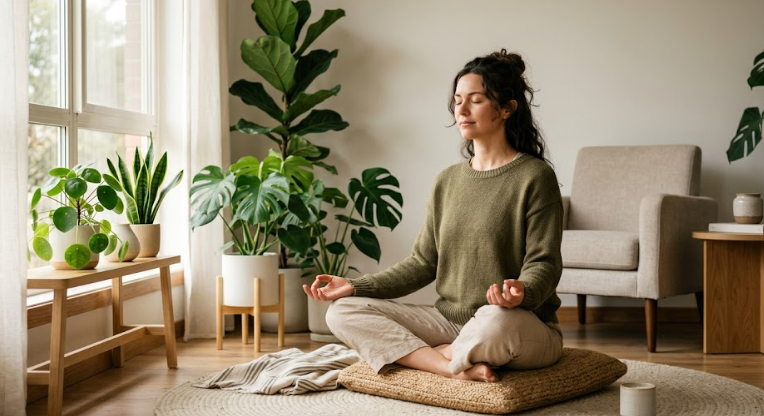
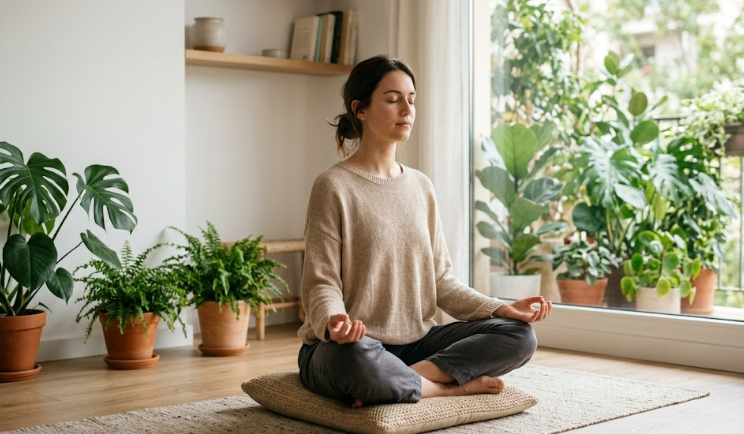
Find a quiet spot — a chair, your bed, or the floor. Keep your back straight but relaxed. Rest your hands gently on your thighs. Close your eyes, or soften your gaze towards the floor. There is no perfect posture. Comfort matters more than form.
Step 2: Take Three Deep Anchor Breaths
Inhale slowly through your nose for
4 seconds. Hold for
1 second. Exhale through your mouth for
6 seconds. Repeat three times. Notice how your shoulders drop and your jaw unclenches. This activates your parasympathetic nervous system — your body's built-in calm switch.
Step 3: Return to Natural Breathing
Let your breath find its own rhythm. Now simply
observe it. Feel the air moving through your nostrils. Notice your belly rising on the inhale. Pay attention to the brief stillness at the top of each breath. You are not controlling anything — just watching.
Step 4: Observe Thoughts Without Following Them
Within seconds, your mind will wander. You'll start planning dinner, reliving an argument, or worrying about a deadline. This is completely normal — it's what minds do. The moment you
notice you've drifted, that noticing is the meditation working. Gently say "thinking" in your mind, and return to the breath. No drama. No self-criticism. Just a quiet return.
This step —
noticing and returning — is the core skill of all anxiety meditation. Each time you do it, you are training your brain to disengage from overthinking.
Step 5: Release the Need for Results
Don't try to force calm. Don't measure whether it's "working." The moment you stop judging your practice is the moment it deepens. Even if you return to the breath 50 times in 5 minutes, you have succeeded. Repetition is the training.
Step 6: End with Awareness
When your timer sounds (start with 5 minutes), don't rush back. Slowly become aware of your body. Wiggle your fingers and toes. Notice sounds around you. Open your eyes gently. Take one final slow breath — and carry this quality of attention into your next moment.
You've just completed a full
meditation for anxiety and overthinking beginners session. That's it.
Breathing Techniques That Amplify Your Meditation
Breath and meditation are inseparable. These three breathing techniques work perfectly before or during any anxiety meditation session:
4-7-8 Breathing
Inhale through your nose for
4 seconds. Hold your breath for
7 seconds. Exhale slowly through your mouth for
8 seconds. This extended exhale directly activates your vagus nerve — your body's main calming pathway. Use this when anxiety spikes suddenly.
Box Breathing (Used by Navy SEALs)
Inhale for
4 seconds. Hold for
4 seconds. Exhale for
4 seconds. Hold for
4 seconds. Repeat four times. This technique resets the nervous system and is particularly effective for racing, looping thoughts.
Extended Exhale Breathing
Inhale for
3 seconds. Exhale for
6 seconds. That's it. Making your exhale twice as long as your inhale shifts your body from a stress state into rest within minutes. Simple enough to do in any situation — at your desk, on public transport, or before sleep.
For a full guide, read our article on
Breathing Techniques for Deep Relaxation.
Time-Based Meditation Routines for Every Need
5-Minute Meditation for Immediate Anxiety Relief
Use this when you feel a sudden wave of anxiety — before a presentation, after difficult news, or when overthinking suddenly spikes. Set a 5-minute timer. Sit or stand wherever you are. Focus on your breath. Label each anxious thought "worry" and return to breathing. Even this brief practice resets your nervous system significantly.
10-Minute Meditation for Daily Practice (Recommended)
This is the sweet spot for most beginners. Long enough to settle into stillness, short enough to fit into any schedule. Follow the full step-by-step routine above, extending the breath-focus section to 8 minutes. Add a 2-minute body scan at the end — mentally travel from your head down to your toes, relaxing each area as you go. A consistent
10 minute meditation for anxiety and overthinking, practiced daily for 8 weeks, has been shown in multiple studies to measurably reduce anxiety levels.
20-Minute Meditation for Deep Calm
On weekends, quiet evenings, or during a stress flare-up, 20 minutes gives you significantly deeper results. Spend the first 5 minutes on 4-7-8 breathing. Follow with 10 minutes of mindfulness breath focus. Close with 5 minutes of Loving-Kindness: silently repeat "May I be calm. May I be safe. May I be free from suffering." This is the most powerful routine for chronic anxiety.
Sleep Meditation for Bedtime Overthinking
Overthinking often peaks the moment your head hits the pillow. A
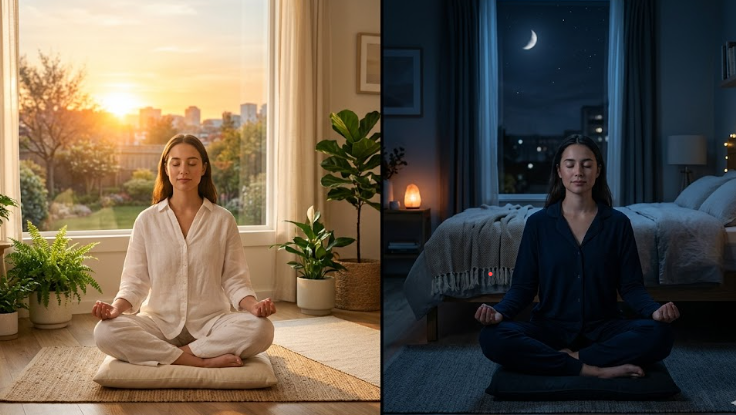
sleep meditation for anxiety and overthinking is specifically designed for this. Lie on your back with arms loosely at your sides. Begin a body scan from your toes upward: as you exhale, mentally say "relax" and feel each body part softening. Move slowly up through your feet, legs, belly, chest, shoulders, arms, neck, and face. If thoughts arise, acknowledge them without engagement and return to the scan. If you fall asleep mid-scan — that's the goal. Combine this with the extended exhale breathing technique for best results.
Morning Meditation for a Calm, Focused Day
Your morning mental state sets the tone for everything that follows. A
morning meditation for anxiety and overthinking — done before your phone, news, or email — creates a buffer of calm before the day's demands arrive. Right after waking, sit up in bed. Do 2 minutes of deep breathing, then 5 minutes of breath-focused mindfulness. Close by setting a conscious intention:
"Today, I will notice anxious thoughts without being ruled by them."
Visualisation Meditation: A Powerful Extra Technique
Visualisation is one of the most underused tools in
guided meditation for anxiety and overthinking. If you find breath-focused meditation difficult to start with, try this instead:
- Close your eyes and take three deep breaths.
- Imagine yourself standing on a quiet beach. Feel the warmth of the sun. Hear the waves. Smell the salt air.
- As anxious thoughts arise, picture each one as a wave that rolls in — and rolls back out. You don't chase it. You just watch it recede.
- Stay in this scene for 5–10 minutes, returning to it each time your mind wanders.
- Slowly open your eyes and take one final breath before continuing your day.
This technique works because vivid mental imagery engages the same brain regions as real sensory experience, effectively giving your stress response a peaceful signal to stand down.
Journaling After Meditation: Deepen Your Practice
Taking 2–3 minutes to write after meditation dramatically accelerates your progress. Your journal doesn't need to be elaborate. Simply answer one of these questions after each session:
- What thoughts kept arising during my meditation today?
- How does my anxiety level compare to when I started (on a scale of 1–10)?
- What did I notice in my body during the practice?
- What is one anxious thought I can choose to release today?
Tracking your experience builds self-awareness, helps you identify anxiety patterns, and gives you tangible proof — in your own words — that the practice is working.
How to Stop Overthinking Naturally (Complementary Techniques)
Meditation works best as part of a broader approach. These evidence-backed methods pair powerfully with your daily practice:
Schedule a Daily "Worry Window"
Tell yourself: "I will think about this from 5:00–5:15 PM." When anxious thoughts arrive earlier in the day, write them down and defer them. This trains your brain to stop treating every worry as urgent — and over time, many worries simply dissolve before the window arrives.
Use the STOP Technique
S — Stop. Pause whatever you're doing.
T — Take one slow, conscious breath.
O — Observe what you're thinking and feeling, without judgement.
P — Proceed with intention and kindness.
This 30-second practice is a micro-meditation you can use anywhere, instantly.
The 5-4-3-2-1 Grounding Method
When overthinking feels overwhelming, this technique pulls you back into the present moment through your senses. Name
5 things you can see,
4 things you can physically feel,
3 things you can hear,
2 things you can smell, and
1 thing you can taste. By the time you finish, you are grounded in now — not lost in a spiral of "what ifs."
Move Your Body
A 10-minute walk interrupts the neurological loop of rumination. As you walk, focus deliberately on your footsteps, your breath, and the sensations around you. Walking meditation is a legitimate, powerful form of
mindfulness meditation for anxiety and overthinking — and you can do it anywhere.
Limit "Anxiety Fuel" Inputs
Scrolling news, social media comparison, and excessive caffeine all feed the overthinking cycle. Protecting your morning and bedtime from these inputs is one of the most practical, underrated strategies for reducing anxiety naturally.
Quick Meditation You Can Do Anywhere (No Cushion Needed)
You don't need a dedicated room, a meditation app, or perfect silence. Here is a
quick meditation for anxiety and overthinking that works at your desk, on a train, in a waiting room, or between meetings:
60-Second Reset:
- Take one slow breath — 4 seconds in, 6 seconds out.
- Notice any tension in your shoulders and consciously drop them.
- Feel both feet flat on the floor.
- Repeat the breath twice more.
2-Minute Breath Count:
- Close your eyes or look at a blank surface.
- Breathe naturally. Count each exhale: 1, 2, 3… up to 10.
- If you lose count, start from 1 again — without frustration.
- After reaching 10, sit quietly for a few seconds before returning to your task.
Nobody around you will know you are meditating. This is genuinely
how to deal with anxiety and overthinking at home — and in every other situation life presents.
Common Beginner Mistakes (And How to Fix Them)
Mistake 1: Trying to Stop Thoughts
The fix: You cannot stop thoughts — and trying to only creates more anxiety. The goal is simply to
notice thoughts without reacting to them. Let them arise and pass like clouds. Your job is to keep returning to the breath, not to empty your mind.
Mistake 2: Expecting Instant, Permanent Results
The fix: One session can create genuine relief, but lasting neurological change takes consistent practice over 6–12 weeks. Treat each session as a deposit in your mental health bank account, not a transaction that delivers instant results.
Mistake 3: Meditating Only When You're Already Anxious
The fix: Practice daily when you're relatively calm. That's when real skill-building happens. Then, when anxiety strikes, your trained nervous system knows exactly what to do.
Mistake 4: Judging Your Meditation as "Bad"
The fix: A wandering mind during meditation is not failure — it's the entire training. Every moment you notice you've wandered and come back is a mental push-up. There is no such thing as a wasted session.
Mistake 5: Forcing an Uncomfortable Posture
The fix: Sit in a chair. Lean against a wall. Lie down. Comfort is not cheating. Physical discomfort during meditation creates more mental distraction — not less. Make ease your priority.
Tips to Get Faster, Lasting Results
- Practice daily: 10 minutes every day produces far greater results than an hour once a week. Consistency beats duration.
- Anchor to an existing habit: Meditate immediately after your morning coffee, or right before brushing your teeth at night. Habit-stacking removes the friction of starting.
- Use guided meditations: Apps like Insight Timer (free) have extensive libraries of guided meditation for anxiety and overthinking — helpful especially in the first few weeks.
- Begin with breathing: Start every session with 2 minutes of 4-7-8 breathing before moving into mindfulness. This primes your nervous system for deeper calm.
- Track your progress: Note your anxiety level (1–10) before and after each session. Within two weeks, you'll have tangible evidence it's working — in your own data.
- Be patient with setbacks: Some days will feel harder than others. That's not regression — that's the natural rhythm of a practice. Return anyway.
For a complete daily routine that fits any schedule, read our guide:
10 Minute Meditation for Stress Relief.
When to Seek Professional Support
Meditation is a powerful, evidence-backed tool for managing anxiety. However, it is a complementary practice — not a replacement for professional mental health care.
Please consider speaking with a qualified therapist or healthcare provider if:
- Your anxiety significantly interferes with daily work, relationships, or physical health.
- You experience panic attacks, severe social anxiety, or persistent intrusive thoughts.
- Anxiety has been present for months without improvement despite consistent effort.
- You are using substances to cope with anxiety symptoms.
Meditation and professional therapy work beautifully together. Many therapists actively encourage mindfulness practice as a complement to CBT (Cognitive Behavioural Therapy) and other evidence-based treatments. Seeking support is a sign of self-awareness — not weakness.
Frequently Asked Questions
Does meditation help with overthinking?
Yes — and the evidence is strong. Meditation teaches you to observe thoughts without identifying with them or reacting to them. Over weeks of consistent practice, the habit of rumination weakens because the brain learns that not every thought requires a response. You develop what researchers call "metacognitive awareness" — the ability to watch your own thinking without being swept away by it.
How long should I meditate for anxiety?
Start with 5–10 minutes daily. A
5 minute meditation for anxiety and overthinking is genuinely enough to feel measurable relief. For lasting neurological change, aim for 10–20 minutes per day consistently over 8–12 weeks. Duration matters less than regularity.
Can meditation reduce anxiety quickly?
Yes. A single
10 minute meditation for anxiety and overthinking can lower cortisol, slow heart rate, and interrupt an active overthinking spiral. For those with chronic or generalised anxiety, the deeper benefits accumulate with daily practice over weeks — not months.
What is the best type of meditation for beginners?
Mindfulness breath meditation is the most accessible starting point — simply focus on your breathing and gently return whenever your mind wanders. If that feels too abstract, try visualisation meditation (imagining a peaceful scene) or a guided meditation from a free app like Insight Timer. Start with 5 minutes and build from there.
Can I meditate lying down before sleep?
Absolutely. A body scan or
sleep meditation for anxiety and overthinking is one of the most effective ways to calm a racing mind at bedtime. Lying down is perfectly valid — and if you fall asleep during the practice, consider that a success.
What if I can't stop thinking during meditation?
This is the most common concern — and the most important myth to dispel. You are not supposed to stop thinking. Every time you notice you've been thinking and return to your breath, you are doing the meditation correctly. A session where you return 30 times is a session where you practiced 30 times. That is progress.
How soon will I see results?
Many people notice a calmer nervous system after just one session. Consistent changes in anxiety levels, sleep quality, and emotional reactivity typically become noticeable within 2–4 weeks of daily practice. The research benchmark for measurable brain changes is 8 weeks of consistent daily meditation.
Your Action Plan: Start Today
Anxiety and overthinking feel like a prison. But the key has always been with you — in your breath and your awareness.
Meditation for anxiety and overthinking doesn't ask you to become a different person. It simply asks you to relate to your thoughts with curiosity instead of panic — and to return, again and again, to this breath, this moment.
You don't need to meditate for hours. Five minutes tomorrow morning is enough to begin.
- Set a reminder right now — "5 min meditation – morning calm".
- Tomorrow morning, follow the step-by-step routine in this guide.
- After one week, increase to 10 minutes.
- When overthinking strikes during the day, use the 60-second reset technique.
- After each session, write one sentence in a journal about what you noticed.
Your mind will still generate anxious thoughts — that is simply what minds do. But with consistent practice, those thoughts will no longer have the power to control your hours, your sleep, or your peace.
One breath at a time. Start today. 🧘
For further reading, explore our related guides: 10 Minute Meditation for Stress Relief | Breathing Techniques for Deep Relaxation