
Morning Meditation vs Midnight Meditation: Which is Better for You? (Complete Guide 2026)
You want to start meditating. Great. But there’s one question that stops you cold:
“When should I do it? Morning or night?”
Every expert seems to give a different answer.
“Meditate at sunrise – it’s the most powerful time!”
“No, meditate before bed – it cures insomnia!”
You’re left confused. So you end up doing nothing.
I’ve been there. After years of trying both, I’ve learned there’s no single “right” answer. Morning meditation vs midnight meditation depends on you – your energy, your goals, and your daily chaos.
In this complete 2026 guide, I’ll break down exactly what happens when you meditate in the morning versus late at night. You’ll learn the morning meditation benefits, the night meditation benefits, and – most importantly – which one fits your lifestyle.
By the end, you’ll know exactly when to meditate. No more guesswork.
What is Meditation?
Before comparing timings, let’s quickly define meditation.
Meditation is a set of techniques that train your attention and awareness. It’s not about emptying your mind. It’s about noticing your thoughts without getting tangled in them. You anchor yourself – often on your breath – and whenever your mind wanders, you gently bring it back.
That’s it. Simple, but powerful.
Whether you practice mindfulness meditation, breathing meditation, or guided meditation, the core remains the same. And the time of day changes how it affects you.
Why Timing Matters in Meditation
Your body runs on an internal clock called the circadian rhythm. This rhythm influences your energy, alertness, hormones, and even body temperature.
- In the morning (after waking), your cortisol naturally spikes. You feel alert, sometimes a little anxious.
- At night, melatonin rises. Your body prepares for sleep. You feel calmer, but also more tired.
Meditation interacts with these rhythms.
Morning meditation works with your natural alertness to build focus and set a positive tone.
Night meditation (or midnight meditation) works with your natural relaxation to release stress and prepare for deep sleep.
Neither is “better” universally. Each serves a different purpose. Let’s explore both in detail.
Morning Meditation – Benefits & Best Use Cases
Morning meditation means practicing within the first hour after waking – ideally before checking your phone or eating breakfast.
Morning Meditation Benefits
- Mental clarity – Your mind is fresh. Fewer distractions have piled up. You can focus more easily.
- Sets a calm tone for the day – Instead of waking up and diving into stress (emails, news, traffic), you start with peace. That calm carries forward.
- Boosts focus and productivity – Studies show that meditation for focus is most effective in the morning when your prefrontal cortex (decision‑making) is rested.
- Reduces morning anxiety – Cortisol is naturally high after waking. Meditation for stress relief in the morning lowers that spike.
- Harder to skip – Morning routines are more consistent. By evening, unexpected tasks often push meditation aside.
Best for:
- Working professionals – You need focus and calm before a busy day.
- Students – Better concentration for classes and studying.
- Anyone who struggles to find time later – Get it done first thing.
- People with morning anxiety – Calm your nervous system early.
Example Routine (10 minutes)
- Sit up straight (even on your bed).
- Close your eyes. Take 3 deep breaths.
- Focus on your breath for 8 minutes.
- End with a positive intention: “Today, I will respond with patience.”
Midnight (Night) Meditation – Benefits & Best Use Cases
Night meditation (or midnight meditation) means practicing close to bedtime – usually 30–60 minutes before sleep. Some people even meditate if they wake up in the middle of the night.
Night Meditation Benefits
- Stress release – You let go of the day’s tensions. Unfinished tasks? Worries? Meditation helps you put them down.
- Better sleep quality – Meditation for sleep activates the parasympathetic nervous system (rest‑and‑digest). You fall asleep faster and wake up less often.
- Emotional calmness – After a hard day, night meditation helps you process emotions without ruminating.
- Lowers nighttime anxiety – Many people feel most anxious when lying in bed. A short meditation for anxiety before sleep breaks that loop.
- Deep relaxation – Your body is naturally winding down. Meditation amplifies that, leading to deep relaxation that improves physical recovery.
Best for:
- People with insomnia or restless sleep – Meditation before sleep is clinically proven to help.
- Overthinkers – If your brain races at night, night meditation gives it a gentle brake.
- Those with high evening stress – Maybe your job ends late, or family responsibilities pile up after dinner.
- Anyone who can’t wake up early – Night owls, shift workers, or heavy sleepers.
Example Routine (10 minutes)
- Lie on your back. Arms relaxed.
- Use a guided meditation app or simply focus on your breath.
- Do a body scan: start at toes, mentally say “relax” as you exhale, move upward.
- If you fall asleep – that’s perfect. You’ve succeeded.
Morning vs Midnight Meditation (Key Differences)
Here’s the comparison table you’ve been waiting for. This table directly answers “morning vs night meditation” searches.
| Factor | Morning Meditation | Midnight (Night) Meditation |
|---|---|---|
| Energy level | High (after sleep) | Low (winding down) |
| Primary purpose | Build focus, set intention | Release stress, improve sleep |
| Best for | Mental clarity, productivity | Relaxation, insomnia, anxiety |
| Typical duration | 5–15 minutes | 10–20 minutes (can be shorter) |
| Effect on alertness | Increases alertness for hours | Decreases alertness (helps sleep) |
| Difficulty | Easier to stay awake | May fall asleep (fine for sleep meditation) |
| Consistency factor | Very high (morning routine) | Medium (evenings are unpredictable) |
| Brain state | Alpha/beta (awake, focused) | Theta/delta (drowsy, relaxed) |
Key takeaway from the table:
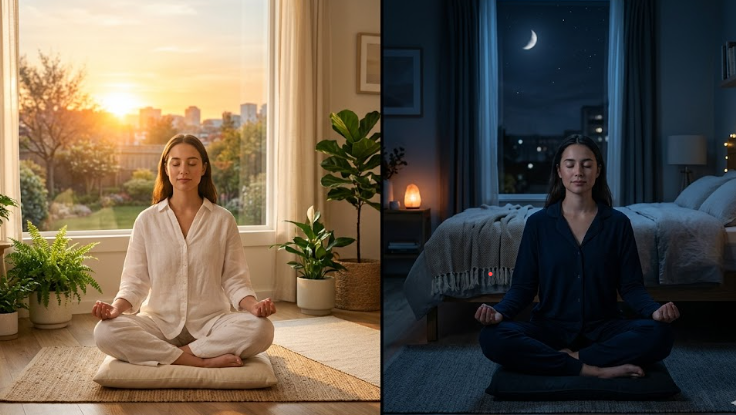
Morning meditation gives you energy and focus. Night meditation gives you calm and sleep. Choose based on what you need more.
Which is Better for You? (Based on Your Life)
Let’s make this personal. Answer these questions:
1. Are you a student or working professional who needs focus?
Choose morning meditation.
You’ll enter work or study with a clear head. Even 5 minutes of morning meditation improves decision‑making and reduces reactivity.
2. Do you struggle to fall asleep or stay asleep?
Choose midnight (night) meditation.
Meditation for sleep is one of the most effective non‑drug insomnia treatments. Combine with a consistent bedtime.
3. Do you feel anxious or overwhelmed in the evenings?
Choose night meditation.
It helps you process the day and release tension before bed. You’ll wake up less groggy.
4. Are you a parent or caregiver with chaotic mornings?
Choose night meditation.
If mornings are impossible (kids, cooking, rushing), night meditation is your anchor. You’ll still get the meditation benefits – just shifted.
5. Do you have time for both? (See next section)
Do both! Many people benefit from a short daily meditation routine that includes 5 minutes in the morning and 5 minutes at night.
Can You Do Both? (Yes – Here’s How)
Absolutely. In fact, many experienced meditators practice twice a day. It’s like eating – small, frequent meals are often better than one huge feast.
Sample “Both” Routine:
- Morning (5–10 minutes): Breathing meditation or mindfulness meditation to sharpen focus.
- Night (10 minutes): Guided meditation or meditation for sleep to wind down.
This gives you the best of both worlds: alert days and restful nights.
If you only have 10 minutes total, split it: 5 minutes morning, 5 minutes night. Consistency beats duration.
Best Meditation Techniques for Each Time
Not all techniques work equally well at different times. Match the method to the moment.
For Morning Meditation:
- Breathing meditation – Simple breath focus wakes up your brain.
- Mindfulness meditation – Observe thoughts without judgement. Great for mental clarity.
- Loving‑kindness meditation – Set a positive intention for the day (“May I be happy. May I be patient.”)
For Night Meditation:
- Guided meditation – Following a voice prevents you from planning or worrying.
- Body scan – Move attention through each body part. Releases physical tension.
- Yoga Nidra (yogic sleep) – A lying‑down meditation that induces deep relaxation.
- Meditation for sleep – Specifically designed to make you drowsy.
Common Mistakes to Avoid (Both Timings)
Mistake 1: Meditating right after a heavy meal
Fix: Wait at least 1 hour. A full stomach makes you sleepy (bad for morning) or uncomfortable (bad for night).
Mistake 2: Using your bed for morning meditation
Fix: Sit on a chair or cushion. Your bed is strongly associated with sleep. You’ll struggle to stay alert.
Mistake 3: Doing an energising technique at night
Fix: Avoid rapid breathing meditation (like Kapalabhati) before bed. It wakes you up. Stick to slow, calming methods.
Mistake 4: Expecting perfection
Fix: Your mind will wander. You might fall asleep. That’s fine. Every session counts.
Mistake 5: Not being consistent
Fix: Pick a time and stick to it for 30 days. Your brain needs repetition to build the habit.
Tips to Stay Consistent
Building a daily meditation routine is easier when you choose the right time for you. Here’s how:
- Habit stack – Attach meditation to an existing habit. Morning: “After I brush my teeth, I meditate.” Night: “After I turn off the TV, I meditate.”
- Start tiny – 2 minutes is better than zero. You can always increase later.
- Use reminders – Sticky note on your mirror, phone alarm, or app notification.
- Forgive missed days – Don’t break the chain? Missed yesterday? Start again today. No guilt.
- Track your streak – Mark an X on a calendar. Watching the chain grow is motivating.
Frequently Asked Questions (FAQs)
1. Is morning meditation better than night meditation?
No – it depends on your goal. Morning meditation is better for focus, productivity, and setting a calm tone. Night meditation is better for stress relief, anxiety, and sleep quality. Both are valuable. Choose based on what you need most.
2. Can I meditate before sleep?
Yes. Meditation before sleep is highly recommended. It lowers cortisol, relaxes your muscles, and shifts your brain into sleep‑friendly waves. Just avoid energising techniques.
3. How long should I meditate?
Start with 5–10 minutes. Research shows significant meditation benefits even at 10 minutes daily. Once consistent, you can increase to 15–20 minutes if you like.
4. What is the best time for meditation?
The best time for meditation is the time you will actually do every day. For most people, morning wins because it’s harder to skip. But night is excellent for sleep and stress. Experiment for one week each.
5. Can I meditate twice a day?
Absolutely. Many experienced meditators practice morning and night. A short daily meditation routine of 5 minutes in the morning + 5 minutes at night is very effective. It gives you both focus and relaxation.
Conclusion
So, morning meditation vs midnight meditation – which wins?
There is no single winner. But there is a winner for you.
- Choose morning meditation if you want mental clarity, focus, and a calm start to your day.
- Choose midnight (night) meditation if you struggle with stress, anxiety, or poor sleep.
- Choose both if you have 10–15 minutes total – you’ll get the complete package.
The only wrong choice is not meditating at all.
Here’s your action plan for 2026:
- Pick one time – morning or night – that feels realistic.
- Commit to just 5 minutes tomorrow.
- Follow the simple technique described above.
- After 2 weeks, decide if you want to add the other time.
You don’t need to be perfect. You just need to start.
And if you’re completely new to meditation, first read our beginner’s guide:
👉 How to Meditate for Beginners at Home (Step‑by‑Step Guide 2026)
Your ideal meditation time is waiting. Start tomorrow morning – or tonight. Either way, begin. 🧘