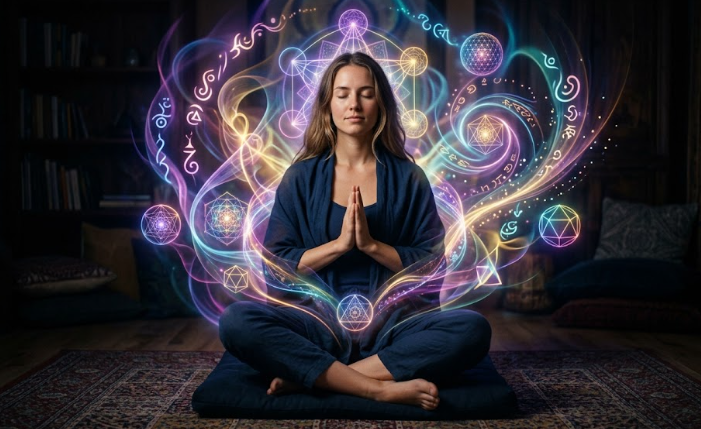
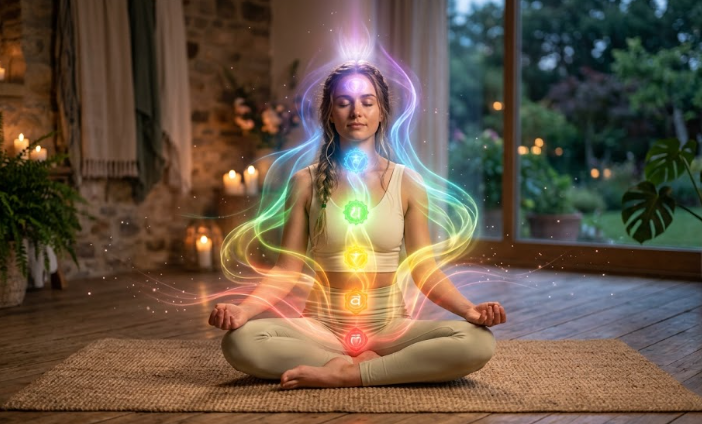
You're sitting in deep silence, following your breath. Suddenly, your closed eyes are flooded with color. A majestic eye gazes back at you. A geometric pattern spins behind your lids. It feels surprising, maybe a little strange. If you've wondered, "Why do I see symbols during meditation?" you are not alone—and nothing is wrong. Thousands of meditators worldwide experience this symbolic imagery. Some see lights, shapes, or even full scenes. This guide will explain the meditation visions meaning, decode the common types, and show you how to integrate them into your practice.
Three years ago, I was sitting cross-legged on a cheap cushion, trying hard not to fall asleep. And then it happened. Behind my closed eyes, a glowing purple eye stared right back at me.
I nearly jumped out of my skin.
Honestly? I thought I was doing something wrong. Every meditation guide I'd read talked about "peace" and "stillness." Nobody mentioned
hallucinations. But here's the thing nobody mentions — thousands of people see symbols during meditation. Lights, shapes, faces, mandalas. It's not weird. It's not a sign you're losing it. And it's definitely not something to chase.
I've spent the last decade practicing and teaching meditation. Seen all kinds of imagery in my own head. Heard from countless students who thought they were broken because their third eye decided to throw a rave. So let me walk you through what's actually happening, what those symbols might mean, and — this part matters — how to work with them without derailing your practice.
What the Heck Is Symbolic Imagery (And Why Does Your Brain Do This?)
Let's call it what it is: pictures your mind makes up while you're meditating. Simple as that.
Sometimes it's just a flash of white light, like someone flicked a flashlight on and off behind your eyelids. Other times? Full-on geometric patterns spinning in slow motion. Faces of people you've never met. Animals. Eyes. Even entire landscapes.
In Buddhist traditions, they call these
nimitta — which roughly translates to "sign" or "hint." The idea is that when your mind gets quiet enough, it starts showing you things. Not because you asked. Just because that's what quiet minds do.
Here's the distinction most people miss: this isn't imagination. Imagination is active. You
choose to picture a beach, a candle flame, a pink elephant. Symbolic imagery just
shows up. Uninvited. Like a dream while you're wide awake.
That's also why it freaks people out.
The Real Reason You See Symbols (Neuroscience First, Then Spirituality)
I'm not 100% sure why some people see vivid imagery and others see nothing for years. But here's what the research — and my own experience — suggests.
Your brain waves change when you meditate. Deep relaxation pushes you into
theta (4–8 Hz) and
alpha (8–12 Hz) ranges. In those states, the barrier between your conscious mind and subconscious gets... squishier. Your visual cortex sometimes fires off random signals. Your brain, being the pattern-making machine it is, turns those signals into pictures.
Sound familiar? It's the exact same thing as hypnagogic imagery — those weird shapes you see right before falling asleep. Except you're awake. And meditating. And wondering if you've finally lost it.
One 2025 study on meditation-induced phosphenes (fancy word for light flashes) found a clear hierarchy: random flickers first, then geometric forms, then dynamic patterns, then full symbolic imagery. So if you're seeing simple shapes now, don't be surprised if they get more complex over time.
Now for the spiritual angle — because it matters too.
From a spiritual perspective, these symbols aren't "just" brain noise. They're messages. From your subconscious, your higher self, your guides — pick your framework. The idea is that when the ego's chatter fades, something deeper can finally speak. And it speaks in images, not words.
Here's what one teacher told me years ago, and I've never forgotten it: "Symbols are the language your soul uses when your brain won't shut up." Fair enough.
Both explanations can be true at once. That's not contradiction — that's nuance. And nuance is where real wisdom lives.
What Different Symbols Actually Mean (From Someone Who's Seen Most of Them)
Let me be upfront: no symbol has one fixed meaning. Context matters. Your life right now matters. That said, certain patterns show up across cultures and traditions for a reason. Here's my cheat sheet.
Light, stars, and colored auras
This is the most common vision people report. A pinpoint of light. A star. A glowing ring.
In the Ananda tradition, they talk about the
spiritual eye — a golden ring with a deep blue center and a silver star in the middle. I've seen versions of this maybe fifty times over the years. Each time, it felt like coming home.
What it usually means: Light equals awareness. Pure, unfiltered consciousness. Seeing it often means you've gotten calm enough to perceive something beneath your usual mental noise. That's not nothing.
Colors add another layer:
Blue — peace, emotional release, throat chakra stuff.
Purple — spirituality, higher wisdom. Feels big.
Yellow — clarity, intellectual insight, sometimes joy.
Green — heart healing. I see this when I've been holding onto something emotionally.
One student saw bright orange for weeks. We looked it up together — creativity, sacral chakra. Turned out she'd been blocking her own art for a decade. Not a coincidence, at least in her mind.
Geometric patterns and mandalas
Spinning shapes. Hexagons. Triangles inside circles inside squares. Sometimes called "sacred geometry."
I remember the first time I saw a mandala unfold behind my eyes. It was beautiful. And then I thought, "Okay, cool, but what does it
mean?"
Here's what I've learned: geometric patterns often show up when your mind is organizing chaos. They represent order — the idea that beneath all the messiness of life, there's structure. The Flower of Life, the Sri Yantra, all of it points to the same thing: everything's connected.
If you see these, don't overthink it. Just notice the precision. The clarity. That's your mind showing you its own hidden architecture.
The eye (yes, the third eye)
This one freaks people out the most. An eye staring back at you while you're trying to relax? Understandable.
But here's the reframe: that's your
Ajna chakra — the third eye center between your eyebrows. It's not something
watching you. It's something
opening inside you.
Every time I've seen the eye, it's preceded a period of strong intuition. Dreams that came true. Knowing who was calling before I looked at my phone. That kind of thing.
Does that mean you'll develop psychic powers? I doubt it. But you might start trusting your gut more. And that's valuable enough.
The lotus flower
If you see a lotus, honestly? That's a beautiful sign.
The lotus grows in mud. Dirty, stagnant, gross mud. And then it rises up and blooms into something perfect. That's your spiritual journey in one image. You're not supposed to start out clean and enlightened. You start in the muck. The blooming happens anyway.
I've seen the lotus exactly twice. Both times, I was going through something painful. The image felt like a promise: "You're not stuck. Keep going."
Animals, teachers, deities
An eagle. A lion. A face you don't recognize but somehow trust.
These aren't external beings — at least, I don't think so. They're parts of you wearing a costume. The eagle might be your own freedom. The lion, your courage. The serene Buddha face? That's your potential for peace, projected outward so you can recognize it.
One meditator I know kept seeing a cobra. Freaked her out completely. Then she learned that in some traditions, the cobra represents kundalini energy — coiled power at the base of the spine, ready to rise. She wasn't being threatened. She was being shown her own dormant strength.
Is This Real or Just My Imagination? (And Does It Matter?)
Fair question. Let me give you a straight answer.
Imagination feels like work. You're actively constructing something. It takes effort to hold the picture in your mind. Let go for a second, and it vanishes.
Spiritual vision feels effortless. It just
appears. Fully formed. Often accompanied by a distinct feeling — peace, bliss, or a sudden "aha" that seems to come from nowhere.
Genuine nimitta (remember that word?) is stable. You can look at it directly, and it doesn't flicker or fade. An imagined image? Look at it too hard, and it dissolves like smoke.
But here's my real take:
don't get too hung up on the distinction.
Whether it's "real" spiritual insight or your brain playing with neural noise — the rule is exactly the same. Don't chase it. Don't cling to it. Don't analyze it mid-meditation. See it. Acknowledge it. Go back to your breath.
The goal of meditation is not to collect cool visions. The goal is to be present. Visions are just decorations along the path. Nice to look at. But you keep walking.
A Simple Step-by-Step for Handling Symbols (Without Losing Your Mind)
Okay, so you're meditating. A glowing purple eye appears. Now what?
Step 1 — Don't panic.
Seriously. The worst thing you can do is react strongly. Excitement pulls you out of focus. Fear does too. Just... breathe. It's fine. You're fine.
Step 2 — Observe for a moment.
Look at it like you'd look at a cloud. "Oh, that's interesting." No need to name it. No need to figure out what it means. Just watch.
Step 3 — Return to your anchor.
Your breath. A mantra. A physical sensation. Whatever you were focusing on before the symbol showed up. Gently — and I mean gently — bring your attention back. The image will fade on its own.
One teacher told me: "If you see a Buddha, don't chase the Buddha. Chase your breath." That stuck with me.
Step 4 — Journal after, not during.
After your session ends, write down what you saw. Colors. Shapes. Emotions. Any insights that came with it. Over time, you'll notice patterns. The symbols will start to make a weird kind of sense.
I've kept a meditation journal for six years now. Looking back, I can trace almost every major life shift to a specific symbol that showed up first. That's not proof of anything. But it's convincing enough for me.
3 Mistakes That'll Mess Up Your Practice (I've Made All of Them)
Mistake #1 — Obsessing over meaning mid-meditation.
You see a flash of blue. Stop meditating. Start Googling "blue light meditation meaning." Congratulations — you just left the state and fed your ego. Save the analysis for later.
Mistake #2 — Trying to force visions.
"I'm going to see something amazing today." That attitude creates tension. Tension blocks genuine experience. Visions happen when you're not trying. That's the annoying truth.
Mistake #3 — Getting attached to one experience.
Had a blissful vision once? Great. Now you're chasing it. And chasing guarantees you won't find it. Let it go. The next session might be boring. That's fine too.
I spent six months trying to get back a single beautiful experience. Guess how many times it came back? Zero. What a waste of energy.
How to Go Deeper (Without Getting Lost in Symbol Land)
Want to work with these symbols instead of getting distracted by them? Try this.
Strengthen your concentration first.
If your focus wobbles constantly, visions will just yank you around. Practice single-pointed attention on your breath for a few weeks. Get stable. Then worry about symbols.
Keep that journal.
I said it before, but it's worth repeating. Write down dreams too. Your subconscious uses the same visual language in both states. You'll start to see connections.
Learn some symbolism — but stay curious.
Read about archetypes. Mandalas. Chakras. Colors. It gives you a map. But don't treat it as dogma. Your symbols might mean something totally different to you. That's allowed.
Try insight practice when you're ready.
This is for more experienced meditators. When a symbol arises, investigate it. Does it have a beginning? An end? Is it solid or constantly changing? What happens if you look closer? That's Vipassana — and it's powerful stuff.
Frequently Asked Questions (From Real People, Not Chatbots)
Why do I see symbols during meditation even though I'm a beginner?
Because your mind quieted down faster than you expected. Beginners see visions all the time — especially if you're visually oriented or naturally creative. It's not a sign of mastery. Just a sign that something shifted.
Is it dangerous to see scary images?
Not dangerous, but unsettling. Dark or chaotic imagery usually means you're processing something your conscious mind avoids. Don't label it "bad." Just observe with the same neutrality you'd give a beautiful image. If it feels truly overwhelming, open your eyes and ground yourself. That's always an option.
What if I never see anything at all?
Also normal. Many longtime meditators see nothing. Ever. And they're perfectly advanced in their practice. Visions are not the goal. You're not missing out.
Do the colors mean the same thing for everyone?
Nope. General guidelines exist — blue for peace, purple for spirituality — but your personal associations matter more. If red means danger to you, that's what it means. Trust your gut.
Should I try to interpret every single symbol?
God, no. Most symbols are just mental tumbleweeds. They don't mean anything deep. Only spend time on the ones that feel significant — the ones that come with a charge or repeat over time.
Your 2026 Action Plan (Short, Simple, Doable)
Here's what I actually want you to do.
- Meditate tomorrow as usual. Don't expect visions. Don't hope for them. Just show up.
- If a symbol appears — breathe, observe for two seconds, return to your anchor. That's it.
- Afterward, open that journal. Write one line. "Saw a spinning gold circle. Felt calm." Done.
- Notice your reaction. Were you scared? Excited? Annoyed? Don't judge it. Just notice.
That's the whole practice. Simple doesn't mean easy. But it works.
Look — you're not broken. You're not hallucinating. You're not doing anything wrong. Your mind is just showing you its invisible furniture. Some of it's beautiful. Some of it's weird. None of it is the point.
The point is the awareness that notices the symbols in the first place. That awareness? That's you. And it doesn't need to see anything at all.
🌌
If you want to go deeper, check out our guide on Chakras and Higher Consciousness — because once you start seeing symbols, the chakras usually aren't far behind.